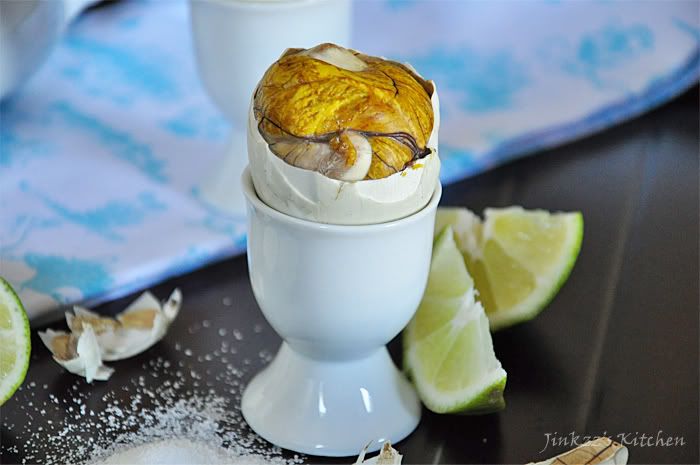
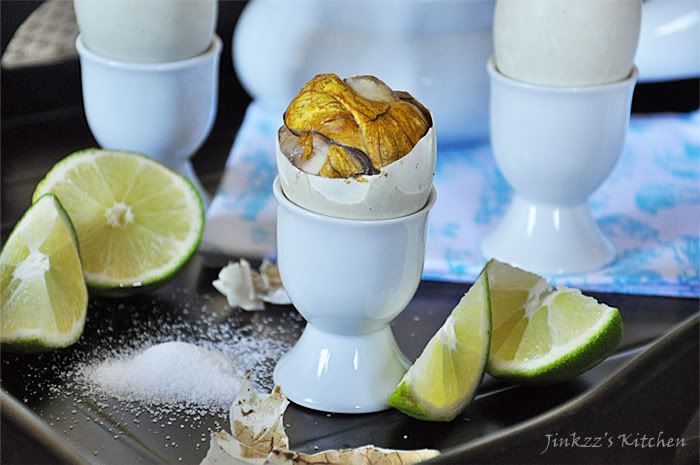
Balut is a fertilized duck egg that has been hard-boiled. The eggs have been incubated for approximately 14-17 days. Balut is a Filipino delicacy but it is also found in other Southeast Asian countries such as Laos, Cambodia, and Vietnam. It is best when eaten while it is still warm. The "sabaw" or liquid soup that is inside balut taste really good. To save the "soup", you need to make a small opening at one end of the balut then sip the soup before making a larger opening to get to the rest of the balut. In the Philippines, balut is usually eaten with a sprinkling of salt and as an accompaniment for beer. In some culture, balut is considered an aphrodisiac.
Balut is sold as a street food which is very popular to people form all walks of life. As popular as it is though, balut is an acquired taste largely in part to the fact that it contains a fully or partially developed chick. Yeah, that might scare even the bravest of the culinary adventurers...hehehe. I, for one, am not too fond of the chick but I do love balut egg yolk which is a lot tastier than a regular egg yolk in my opinion. I mostly eat the yolk and either discard or give the chick to someone else. The egg white in balut is not edible because it is hard and rubbery. This one I usually discard.
I have fond memories associated with balut not because I like eating them but because it evokes a warm and fuzzy feeling. Back in the Philippines, Thursdays usually meant payday for those who works at the sugar central where my father worked which also houses a housing compound for employees and their family. Payday also meant there are a few vendors who sells their goods such as balut, seasonal fruits, and other food items to employees who pick-up their salary from one of the office buildings. My dad will sometimes bring us with him when he picks-up his pay envelop and buy us goodies... ahhh, life was simple then but the happiness brought by such a simple gesture is so profound. I do sometimes long for those times when media put less emphasis on commercialism and more on family. Or, maybe I was just too young to know any better...hehehe... anyways, those are part of the happy memories that will remain with me for as long as I live :)
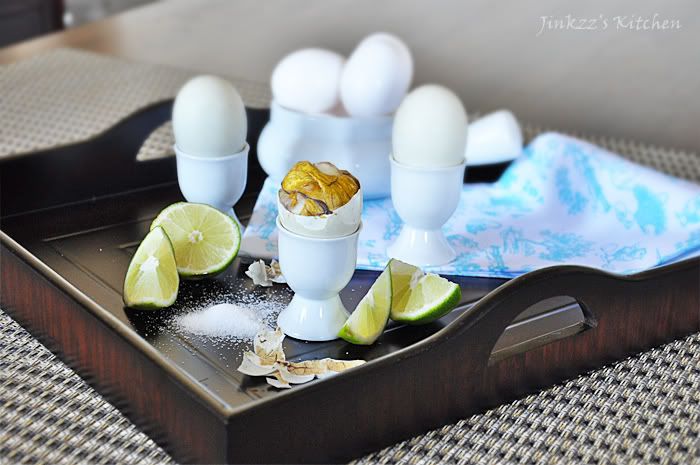
Ingredients:
uncooked balut
water for boiling
salt, vinegar, or chili sauce (if desired)
1. Place balut in a sauce pan and cover with water.
2. Bring water to a boil over medium heat and boil between 20- 30 minutes
**** NOTE: I am not really too sure about how long to boil the balut. I searched the net but got different info. I boiled mine for about 30 minutes just to make sure that everything is cooked.
3. Remove form heat, let it cool down a bit before serving it warm with a side of salt, chili sauce, or vinegar.
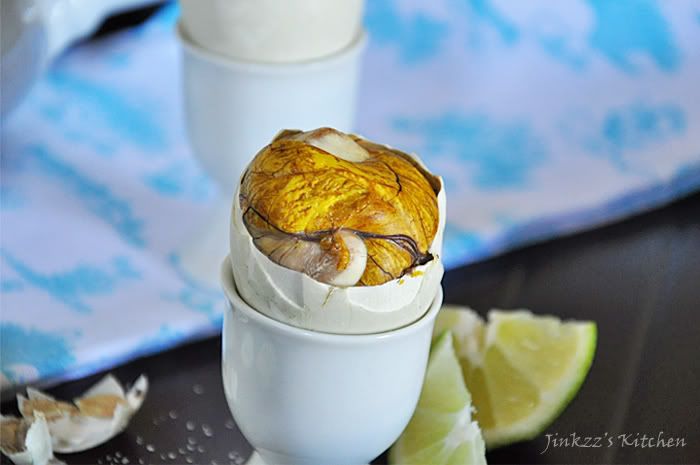
NOTE: I used pictures that are not graphic because I was scared that showing a full grown embryo in the balut might scare a lot of people. For a picture of balut with the full-grown embryo, you can refer to the ones posted at wikipedia. :)
Showing posts with label street food. Show all posts
Wednesday, May 23, 2012
Saturday, August 13, 2011
Banana-que and Kamote-que
I have been wanting some banana-que for quite some time now but everytime I go home to the Philippines, I always chicken out from buying street food in fear that I might get sick...hahaha...I think the older I get, the more sensitive my stomach becomes. Anyways, my friends got some banana-que when we went to the public market but I didn't eat any. Instead, I opted to eat some santol which, to my dismay, gave me a belly ache early the following morning. Well, to appease the cravings, I made some banana- and kamote-que today. I bought some sab-a banana from the Filipino store yesterday and kamote from the korean market the other day.
Ingredients:
Sab-a banana (plantain), peeled and cut in half
kamote, peeled and sliced thickly and diagonally
brown sugar (i used dark brown sugar)
vegetable oil
1. Heat oil in a pan over medium heat. cook banana and kamote separately. WARNING: Be careful not to burn yourself.
2. Cook until light golden brown. Remove from heat and transfer to a platter.
3. Remove some of the oil from the pan, leaving just enough to caramelize the brown sugar. Be careful not to burn the caramelized sugar otherwise it will taste bitter.
4. Add the fried banana or kamote a little at a time. Coat all sides and skewer.
NOTE: I find that the easiest way to skewer the banana or kamote que is using two bamboo skewers. One will hold it steady and the other will be used to pierce through and skewer.
Ingredients:
Sab-a banana (plantain), peeled and cut in half
kamote, peeled and sliced thickly and diagonally
brown sugar (i used dark brown sugar)
vegetable oil
1. Heat oil in a pan over medium heat. cook banana and kamote separately. WARNING: Be careful not to burn yourself.
2. Cook until light golden brown. Remove from heat and transfer to a platter.
3. Remove some of the oil from the pan, leaving just enough to caramelize the brown sugar. Be careful not to burn the caramelized sugar otherwise it will taste bitter.
4. Add the fried banana or kamote a little at a time. Coat all sides and skewer.
NOTE: I find that the easiest way to skewer the banana or kamote que is using two bamboo skewers. One will hold it steady and the other will be used to pierce through and skewer.
Subscribe to:
Posts (Atom)